Founder · Opportunity Data
Benazir Rowe, Ph.D.
I build open, reproducible infrastructure that turns public data into evidence anyone can act on.

I build open, reproducible infrastructure that turns public data into evidence anyone can act on.
I founded Opportunity Data to improve decision making with public data. Students, institutions, policymakers, workforce boards, employers, researchers, and funders make consequential decisions with public data they cannot use, because the data is fragmented, coded differently across agencies, and published for reporting rather than for choices. Opportunity Data builds the open infrastructure that closes the gap between public data and the decisions public data should inform. The ethos is simple: build open infrastructure from public data.
The open layer is free and documented. Openness is how the work earns trust and reach. Paid engagements apply the same infrastructure to specific decisions for states, systems, and institutions. Education-to-workforce pathways are the first domain. The same infrastructure applies to every domain where public data exists and decisions get made without it.
Every measure draws on open sources, including O*NET, IPEDS, Census PSEO, BLS, and state policy data, and every method is documented so the work can be checked, reused, and built on. Complex public datasets become legible enough to act on, without ranking institutions or reducing anyone's choices to a single number.
Workforce Pell took effect on July 1, 2026. For the first time, federal Pell Grants fund short-term workforce programs, states are building approval processes from scratch, and a value-added earnings test decides which programs qualify. AI is changing the skills that economic opportunity rewards, and the public data that describes programs and occupations was never built to show where that exposure sits. Public funding is increasingly tied to evidence of program quality, labor-market alignment, and earnings.
The public data behind those judgments is vast, fragmented, and hard to use. It sits across federal surveys, state systems, and occupational databases, each with its own structure and caveats. Decisions about which programs to fund, approve, or expand get made without a clear view of the evidence, not because the data is missing, but because assembling and interpreting the data is expensive. Opportunity Data brings the sources together, holds them to a consistent standard, and publishes the results for everyone who needs them.
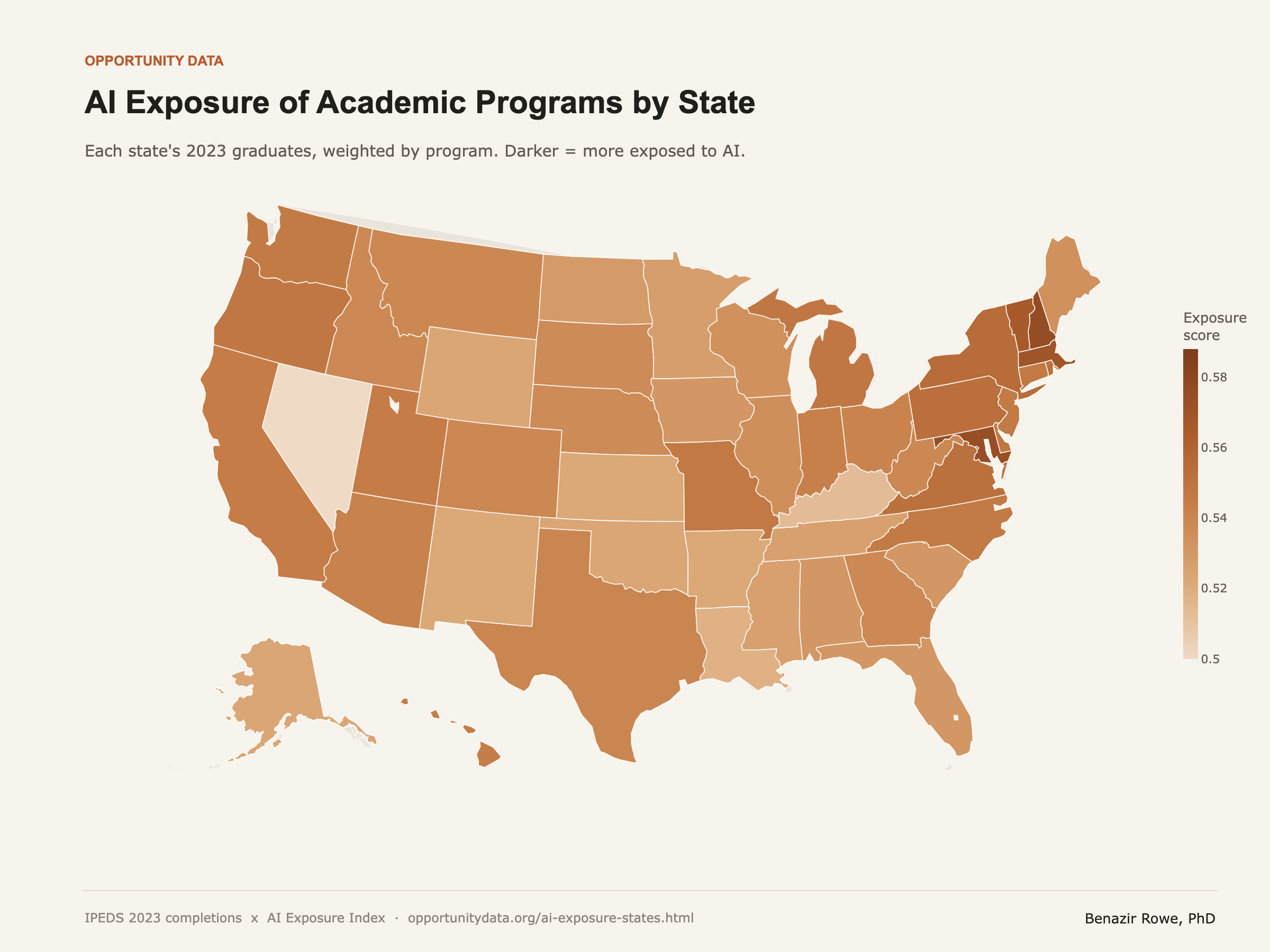
1,806 academic programs and 696 occupations, covering roughly 119.5 million workers, scored across three dimensions: digital intensity, human-interaction shield, and physical anchor. A companion analysis maps AI exposure for all 50 states and DC using 5.3 million IPEDS 2023 completions.
Workforce Pell implementation across 52 jurisdictions, verified against each state's own agencies and workforce boards and kept current. NPR and Child Trends draw their state counts from the Record.
How states convert the federal rule into occupation lists and program approvals, side by side. The differences are large: Pennsylvania's first list named 19 occupations where North Carolina's named 364.
Census PSEO graduate earnings at 1, 5, and 10 years across 900 or more institutions and 33 states, with an explicit account of what the data suppresses and what the data can and cannot answer.
Underemployment and early-career pay across 73 bachelor's fields, so program design and evaluation can rest on evidence rather than assumption.

I am a statistician, trained across statistics, economics, and finance. I hold a Ph.D. in Statistics from the University of Nevada, Las Vegas, a graduate degree in international economics and finance earned as an Open Society Foundations scholar, and an undergraduate degree in mathematical economics.
My work has always been close to the data public decisions rest on. In state government and in community-college institutional research, I built and analyzed the education and workforce evidence behind funding, accountability, and program approval, the numbers that decide which programs grow and which are cut. I know how that data is produced, where it is thin, and how easily it is misread.
Opportunity Data is where that experience becomes infrastructure: deep public datasets, rigorous methods, and frameworks built to be used and checked. I build and publish the platform end to end, from federal microdata to the page, and I have worked in Python for more than a decade. Independent, reproducible, and in the open.
When the data cannot answer a question, the honest result is to say so, not to estimate past the evidence.
Benazir RoweThe State Implementation Record is the source behind NPR's state count on Workforce Pell readiness and Child Trends' state-by-state analysis of early care and education occupations under the program.
Whether you use this work, build on it, or want to partner, let's talk.