
A collaboration
Opportunity DataOpportunity Data Good Energy CollectiveGood Energy Collective
Workforce Pell · Sector Lens

The nuclear energy workforce and Workforce Pell

The nuclear workforce is the set of trades and technical occupations that build and operate nuclear reactors: welders, pipefitters, electricians, ironworkers, and boilermakers during construction; reactor operators, radiation protection technicians, and maintenance crews once a nuclear power plant is running. Demand for the nuclear workforce is rising for a concrete reason: data centers used 4.4 percent of US electricity in 2023 and are projected to reach 6.7 to 12 percent by 2028 (LBNL for DOE, December 2024). AI’s energy appetite calls for creative solutions at grid scale, and nuclear is existing technology able to supply firm, always-on power in those quantities. The bottleneck is the workforce: the nuclear power plants announced for the 2030s need tradespeople and technicians that today's training pipelines do not produce in the numbers required.

Workforce Pell funds short-term training only for occupations a state places on its eligible list, so whether the nuclear workforce pipeline can use the program depends on state-by-state design. This analysis takes a full nuclear staffing taxonomy, 78 roles across 61 occupations from construction through operations, and tests it three ways: whether Workforce Pell can reach each occupation at all, where the training programs actually exist, and what the five Innovation Campus finalist states have approved so far, mapped against the operating reactor fleet and the AI data center buildout.

Three findings:

  • Weighted by demand, the first stage of a nuclear power plant build is largely Workforce Pell territory: 81 percent of peak-construction need is in occupations the instrument can reach.
  • The gaps are structural: of the 61 occupations, 27 are degree-track, 8 map to no instructional program in the federal taxonomy, and the thinnest trades, boilermakers first among them, clear no Workforce Pell eligibility screen that currently exists in any finalist state.
  • None of the five states the U.S. Department of Energy (DOE) just selected as finalists to host Nuclear Lifecycle Innovation Campuses, Utah, Tennessee, Oklahoma, Louisiana, and Idaho (announced July 28, 2026), has posted an approved Workforce Pell occupation list or program roster, so what the program will fund where the campuses are going is not yet decided.
Download the brief (PDF)

Where AI compute is being built

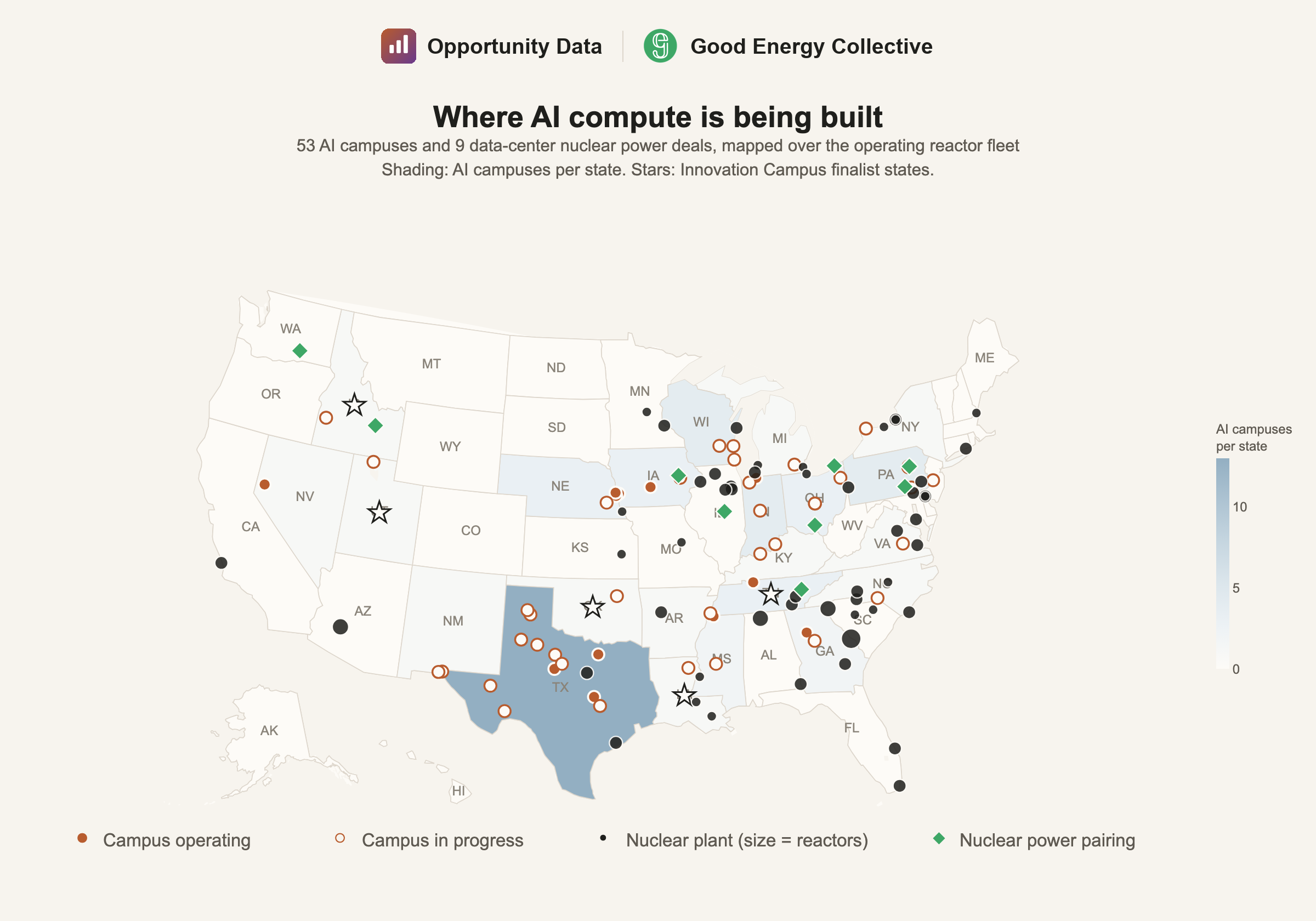
Fifty-three major AI data center campuses are operating, under construction, or announced across the country, alongside nine deals that pair a data center operator with nuclear power: restarts at Three Mile Island and Duane Arnold, the Amazon-Susquehanna and Meta-Clinton agreements, advanced-reactor commitments, and the newest, Crusoe and Aalo Atomics’ July 30, 2026 agreement to deploy a modular AI data center at Idaho National Laboratory in 2027, powered by a small modular reactor. Every site is sourced to a company, state, or utility announcement. All five Innovation Campus finalist states now have AI data center activity: xAI in Memphis, Meta in Tulsa, Meta’s Hyperion in Richland Parish, Louisiana, Meta’s Kuna campus under construction in Idaho, and the state-chartered Stratos project area announced in Utah’s Box Elder County, where the state development authority paused its role in July.

Nuclear power and AI data centers sit in the same geographical corridor.

The AI buildout concentrates in the same Midwest-to-mid-Atlantic band where the reactors already operate, and most of the pairing deals are being struck there. Both draw on the same electricians, pipefitters, welders, and HVAC trades, and the data center schedule is years ahead of the nuclear one. The synergy potential is real and mostly unnamed: states are planning the two buildouts on separate tracks, and workforce policy is where the tracks could meet.

US map of 53 major AI data center campuses by status and 9 data-center-driven nuclear power pairings, with the five Innovation Campus finalist states shaded

The first stage of a nuclear power plant build is Workforce Pell territory

For states standing up nuclear power plant infrastructure, Workforce Pell covers the build itself: 81 percent of peak-construction demand, weighted by staffing need, is in occupations the program can reach, and construction is where the headcount concentrates, roughly ten times the FTEs of the operations phase. A funded certificate is also a foot in the door, drawing people into the education pipeline who can stack toward the operations and degree-track roles that dominate later, when the reachable share falls to 55 percent.

The timelines make this a present-tense decision. Announced construction targets 2030 and eligibility screens are being set now, so a state expecting a build in a few years needs to plan the educational pipeline today, and to screen for the future it wants rather than the status quo it has: the screens in force were built from yesterday’s labor-market data, before any of these states knew it would be asked to staff a reactor campus. For long-horizon projects with known labor demand, approval can work ahead of supply: opening eligibility before programs exist gives colleges and employers a reason to connect and stand up the programs the future demand requires, and those programs qualify for Workforce Pell as they launch. The division of labor is clean: the state approves an occupation because the occupation meets state goals, colleges build programs that teach it well, and employers hire and pay the people who complete them. The phase the instrument can fund is the phase that arrives first.

2026
States set Workforce Pell screens and lists
2030
Announced construction start; peak-construction demand follows
Mid-2030s
Commissioning, then steady-state operations
Peak constructionmodeled snapshot: 6,860 FTE
Steady-state operationsmodeled snapshot: 620 FTE
A · Reachable, visible supply B · Reachable, near-invisible trades C · No program mapping D · Degree-track

Shares are demand-weighted using the taxonomy’s 34 staffing-sourced roles, medium build scenario, shared-SOC duplicate figures removed; classification bands per the methodology note below. The construction snapshot models two units in peak construction; the operations snapshot models two units in steady state and one in commissioning, so totals are not per-unit comparable. Estimate-tier roles are excluded from the weights.

In many states, employers hold formal power in Workforce Pell program approval

In 10 of the 16 published frameworks, employer sign-off is on the critical path: a training program cannot qualify without documented employer demand. For utilities, constructors, and suppliers, a handful of letters can unlock, or their absence can block, Pell-funded training pipelines. Several states also fast-track Registered Apprenticeship instruction.

3+ employersMinnesota and South Dakota (standardized validation forms); Maryland (letters from three or more in-state employers, or one sector-partnership or local-workforce-board endorsement)
2+ employersNorth Carolina, Nebraska, Michigan, Arkansas; Texas requires exactly two letters with prescribed content
1 employerAlabama (endorsement letter, or a WIOA industry-recognized credential); Illinois (one letter plus competency evidence, or a job-postings analysis)
Open menu, no minimumPennsylvania, Ohio, Iowa, Colorado
No institutional testFlorida and South Carolina resolve demand state-side

Where the programs are: supply behind the full nuclear power plant staffing taxonomy

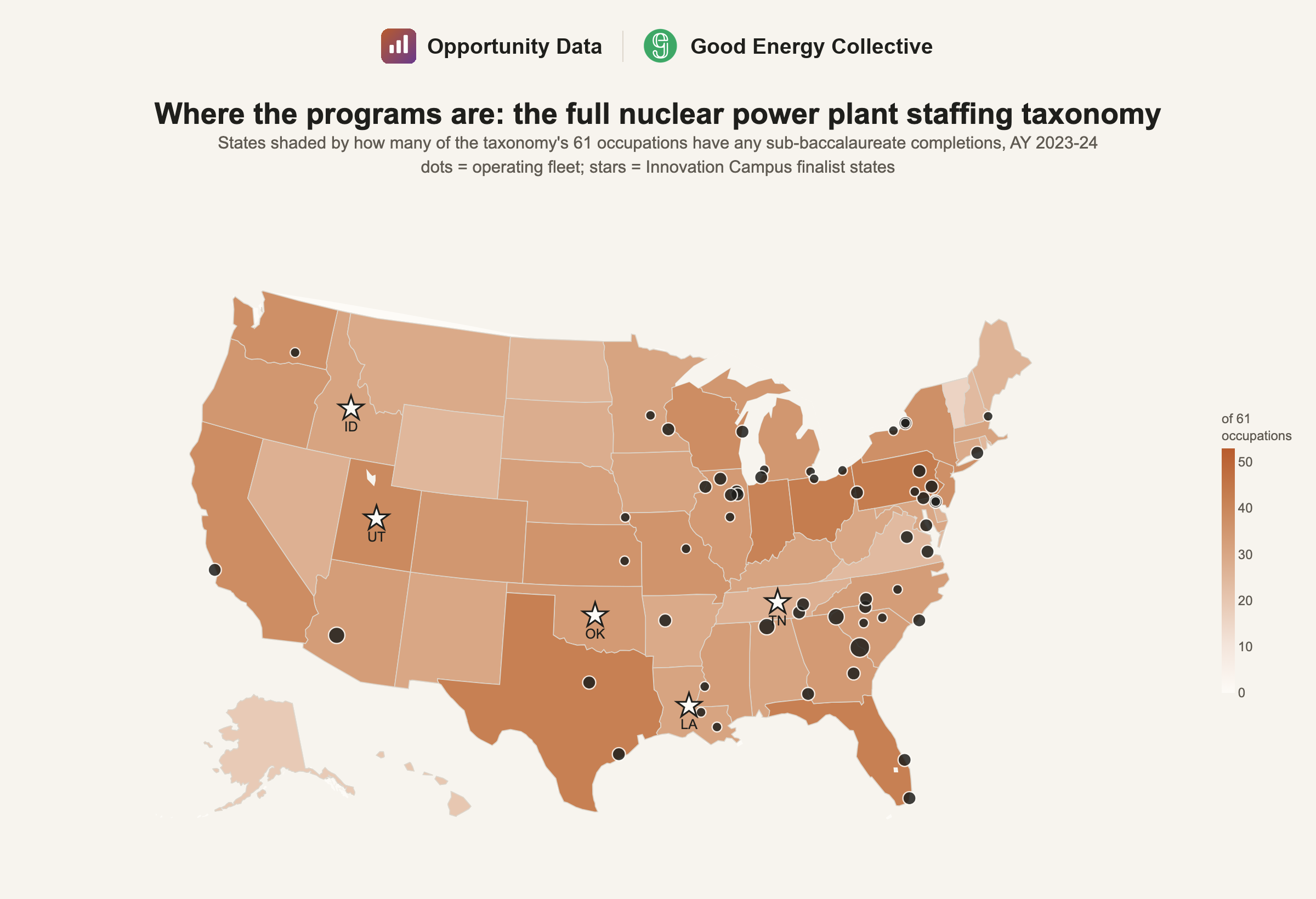
The staffing taxonomy’s 61 occupations cover the full arc of a nuclear power plant: the construction trades (welders, pipefitters, electricians, ironworkers, boilermakers), manufacturing and maintenance technicians (CNC machinists, instrumentation and control, NDT, HVAC), licensed operations (reactor operators, power plant operators), radiation protection, engineering, and plant administration. The map shades each state by how many of the 61 have any sub-baccalaureate completions reported to IPEDS (2023-24); states with none stay in the background color, and stars mark the five Innovation Campus finalist states.

No state covers all 61 occupations, because eight of them cannot be covered at all: the federal taxonomy maps no instructional program to them, so the most any state can reach is 53. The invisible eight are concrete workers and laborers, structural ironworkers, factory assembly technicians, fuel handling technicians, fuel fabrication workers, document control specialists, supply chain and warehouse staff, and general administrative staff. And training capacity alone is not enough: a state needs an occupation on its Workforce Pell eligibility screen and a program that trains it before the funding can reach a single seat.

The most nuclear-specific needs are the least visible to Workforce Pell and Title IV.

Fuel fabrication workers and fuel handling technicians have no instructional-program mapping in the federal CIP taxonomy, so no Title IV program anywhere can be classified as training them, and DOE names fuel fabrication and used-fuel handling among the core activities of the Nuclear Lifecycle Innovation Campuses, so the two occupations at the center of the federal campus program are ones no state screen can reach, however the state writes it. The same holds for structural ironworkers, concrete workers, and factory assembly technicians on the construction side. Boilermakers, insulation workers, cement masons, and power plant operators have program mappings but under 100 sub-baccalaureate completions each nationally, boilermakers just 25. The trades with deep national pipelines, welders, electricians, and pipefitters, clear every live screen; the roles that distinguish a nuclear build barely register in the federal training data.

Invisible does not mean untrained. Structural ironworkers and boilermakers come up through registered apprenticeships and union training centers; fuel handling and fuel fabrication workers are trained by employers on the job. Those channels sit outside the federal instructional-program taxonomy, and while not every state builds its eligibility screen on that taxonomy, most do: a limited instrument with heavy use, whose blind spots propagate into state eligibility decisions. The instrument’s boundary defines the policy choice. Workforce Pell reaches the college-taught share of the buildout, and a college can extend that reach by delivering a registered apprenticeship’s related instruction; the rest of the staffing table takes non-Pell funding for the apprenticeship and employer pathways, or a classification fix that rests with the federal statistical agencies rather than the states.

US map: states shaded by how many of the 61-occupation nuclear staffing taxonomy have any sub-baccalaureate completions in IPEDS 2023-24, with operating nuclear plants as dots and the five Innovation Campus finalist states starred
State training capacity
For employers and builders siting nuclear work, a first read on each state’s training capacity: how many of the 61 occupations its institutions already produce (terracotta), and where a state has published a Workforce Pell occupation list, how many of the 61 it approves (blue). Pennsylvania trains 43 but approves just 6 of the taxonomy; Ohio approves 46, including occupations it does not yet train. ★ marks an Innovation Campus finalist.
1Ohiotrains 43 · approves 46
1Pennsylvaniatrains 43 · approves 6
3Floridatrains 42 of 61
3Texastrains 42 of 61
5Indianatrains 41 · approves 5
6Utah trains 39 of 61
7Californiatrains 38 of 61
7Wisconsintrains 38 of 61
9New Jerseytrains 37 of 61
9Washingtontrains 37 of 61
9New Yorktrains 37 of 61

Among the finalists, Utah ranks 6th nationally; Oklahoma is 17th (34 of 61), Louisiana and Idaho tie for 25th (31), and Tennessee is 39th (27). Texas has a 25-occupation statewide list not yet parsed against the taxonomy; Florida approves programs rather than occupations; the remaining states shown have not published occupation lists or run program-by-program approval instead.

The five finalist states

Utah, Tennessee, Oklahoma, Louisiana, and Idaho were named finalists for federal nuclear Innovation Campuses on July 28, 2026. Each is also deciding, on a separate track, what Workforce Pell will fund. Status below is verified against each state's own documents.

The selection rewarded proposals, not installed bases. DOE ran the competition through a memorandum-of-understanding process, drew 28 applications from 26 states, and evaluated how a campus “would advance goals such as workforce development, infrastructure investment, economic diversification, or technology leadership” (DOE, July 28, 2026). The Innovation Campus program centers on the fuel cycle: fuel fabrication, enrichment, reprocessing, and final disposition of used fuel, with reactor deployment, power generation, advanced manufacturing, and co-located data centers as state options. The cohort reflects that design: Utah and Oklahoma operate no commercial reactors, Idaho’s nuclear asset is the Idaho National Laboratory rather than a power fleet, and Tennessee (Watts Bar and Sequoyah, four units) and Louisiana (Waterford and River Bend, two units) have modest operating fleets. The largest fleet states are absent from the cohort, and in the fuel-cycle segments the campuses target, no US state has commercial capacity at scale, so every applicant was proposing new capability.

Tennessee
Live

Occupation screenCriteria, not a list: in-demand, high-skill, or high-wage alignment, employer validation, and the 70 percent completion and placement thresholds. The portal posts a CIP-SOC alignment crosswalk of 393 CIP codes mapping to 306 occupations; ten of the twelve nuclear-relevant occupations appear in it, including nuclear technicians and nuclear power reactor operators. Boilermakers do not.

Approved so farNothing yet. The August 28 board agenda is posted with no Workforce Pell item, so the November 6 meeting is the board's remaining 2026 opportunity for first approvals; the last board action on the program is the June 23 framework approval.

Louisiana
Live

Occupation screenTwelve qualifying CIP program families rather than an occupation list, spanning construction trades, industrial maintenance, precision metal work, and electromechanical technology (updated June 29, 2026). The feeder families for welding, electrical, pipefitting, HVAC, industrial maintenance, and instrumentation are all in. Boilermaking and nuclear technology are not.

Approved so farA first group of eligible programs identified by the Board of Regents; the roster is not posted. Colleges cannot apply on their own initiative until award year 2027-28.

Idaho
Live

Occupation screenThe Workforce Development Council's in-demand careers matrix, 278 occupations in its published form. Welders, electricians, pipefitters, machinists, structural ironworkers, insulation workers, and millwrights are on it. Boilermakers and both nuclear-titled occupations are not.

Approved so farPilot cohort applications are being accepted under the EO 2026-05 coordinating council; no program roster is posted.

Utah
In progress

Occupation screenNone published. Board Policy R132 (July 2026) codifies the governor-to-board delegation enacted in SB 195; no occupation criteria or application channel exists yet.

Approved so farNone.

Oklahoma
In progress

Occupation screenNone. A coordination venue is named in the state's Workforce Transformation Plan; no approval process, application, or governor action has been announced.

Approved so farNone.

Findings across the five states

1The AI buildout

The demand driver is present in every finalist state, at different stages.

Tennessee (xAI in Memphis), Oklahoma (Meta in Tulsa), and Louisiana (Meta’s Hyperion in Richland Parish) host major campuses operating or under construction; Idaho has Meta’s Kuna campus under construction and the cohort’s only signed data-center nuclear pairing, Crusoe and Aalo Atomics’ 2027 deployment at Idaho National Laboratory; Utah’s state-chartered Stratos project area is announced, though the state development authority paused its role in July 2026. In every case the data center buildout and the Innovation Campus bid draw on the same electricians, pipefitters, welders, and HVAC trades, and the data center schedule is years ahead of the nuclear one, so a training pipeline built for the data center work now is the same pipeline an Innovation Campus can draw on later. The overlap is a sequencing advantage for a state that plans the two buildouts together.

2State screens

The screens diverge in architecture and converge in coverage.

Three live states use three designs: Tennessee screens by criteria, Louisiana by CIP program families, Idaho by an occupation matrix. All three admit the shared construction trades (welders, electricians, pipefitters) and none admits boilermakers, the trade with 25 sub-baccalaureate completions in the national federal data; nuclear-titled occupations appear only in Tennessee’s crosswalk. A college or employer consortium working across the cohort faces a different evidentiary path in each live state to fund the same welding certificate.

3Capacity and process

Process maturity and training capacity are inverted.

The two states with no live application process rank highest in training capacity (Utah 6th nationally at 39 of 61 occupations, Oklahoma 17th at 34), while the three states with live processes rank lower (Louisiana and Idaho tied at 25th with 31, Tennessee 39th with 27). The states with the most programs to approve have no channel yet; the states with channels have thinner existing supply behind them. The gap between the two is where aspirational approval works: an occupation made eligible before programs exist signals institutional priority, the approval-ahead-of-supply model described above, and Ohio already approves occupations it does not yet train. A state with training capacity but no channel cannot send that signal.

A Workforce Pell list built from old labor-market data funds the workforce a state already has. Federal law already lets a state approve for the workforce it plans to build.

The in-demand definition has two halves, and most states operationalize only the first. Federal law defines an in-demand occupation as one that “currently has or is projected to have” a significant number of positions (29 U.S.C. § 3102(23)).

“Currently has” is the half the lists are built on: published employment data that is roughly a year old at release, and occupational projections extrapolated from staffing patterns whose base year can sit two to four years back.

Simple time-series extrapolations cannot see a discrete commitment like a reactor campus. “Is projected to have” is the half that can: the U.S. Department of Energy’s July 28, 2026 shortlisting of Utah, Tennessee, Oklahoma, Louisiana, and Idaho for nuclear campuses is documentation of projected demand a state screen can accept today, and a nuclear buildout’s decade-long horizon is exactly what the forward half of the definition is for. Workforce Pell adds room on top: the statute leaves “in demand” to each governor’s published methodology, so a state can write projected demand into its own criteria directly.

Shifting Workforce Pell approvals from recorded demand to projected demand unlocks federal workforce funding that is already authorized; the change requires no new statute and no new appropriation, only a different reading of a definition already on the books.

The WIOA definition behind most state in-demand lists

The half states usually operationalize
“currently has”
  • BLS occupational employment data, about a year old by the time it is published
  • Long-term projections extrapolated from staffing patterns with base years two to four years back
  • Extrapolation assumes continuity, a weak assumption under technological (AI), political, and geopolitical disruption
Funds the workforce the state already has
The half the finalist selection satisfies
“is projected to have”
  • DOE nuclear campus shortlisting, July 28, 2026: a documented federal commitment naming the state
  • Reactor construction targeting 2030, with a decade of staffing demand behind it
  • The selection itself is documentation of projected demand a state screen can accept
Approves the workforce the state plans to build

For long-term infrastructure projects such as a nuclear power plant build, the second half of the definition is what moves the needle: it unlocks federal workforce funding that is already available, now.Opportunity Data · Good Energy Collective

Methodology note: testing a full nuclear staffing taxonomy

A full nuclear staffing taxonomy covers 78 roles across 61 SOC occupations, spanning construction, manufacturing, operations, maintenance, engineering, radiation protection, and administration. Before any coverage claim, each occupation is classified by whether Workforce Pell can reach it at all:

Of the 61 occupations in the demand taxonomy, 21 are occupations Workforce Pell can plausibly reach. Four of those appear on all three machine-readable state lists held here; seven of the 61 appear on no held list. The degree-track classification describes the occupation’s credential, not the student’s path: a Workforce Pell certificate can still be a stackable first step toward a degree-track occupation, which is what the statute’s stackability requirement is designed for. But the occupation itself is not fillable by the certificate, so degree-track rows are excluded from coverage claims. Typical entry education is BLS Employment Projections Table 5.4; completions are IPEDS 2023-24 sub-baccalaureate awards; checks show membership on the published Colorado (434), North Carolina (364), and Pennsylvania (19) lists.

Weighted by demand rather than count, the picture shifts. Using the taxonomy’s 34 staffing-sourced roles (medium build scenario, shared-SOC duplicate figures removed), 81 percent of peak-construction FTE demand sits in occupations Workforce Pell can reach, 10 percent in the thin trades, and 9 percent in taxonomy-invisible occupations; at steady-state operations the reachable share is 55 percent, with 37 percent degree-track. The by-count split describes the taxonomy, the demand-weighted split describes the workforce, and construction demand concentrates heavily in the reachable trades. Weights use sourced staffing figures only, so estimate-tier roles are excluded, and the staffing model’s lockstep phasing means construction trades carry the five-year snapshot and operations roles the fifteen-year one.

The full 61-occupation table

Occupation-by-occupation rows: typical entry education, national completions, state-list membership, and the sourcing and SOC-vintage notes. The row-level detail is in the document.

Download the methodology note (PDF)

Method and sources

The occupation frame is a 78-role nuclear staffing taxonomy spanning 61 SOC occupations, developed with Good Energy Collective’s Nuclear Workforce Compass; demand weights use its Vogtle-sourced staffing figures. Program supply is IPEDS Completions 2023-24 joined through the NCES CIP-SOC crosswalk; typical entry education is BLS Employment Projections Table 5.4. Occupation-list checks use the three machine-readable state lists in hand (Colorado 434, North Carolina 364, Pennsylvania 19); the five finalist states’ eligibility screens are verified against each state’s own documents, and employer-evidence requirements come from each state’s published policy instrument. AI data center campuses and nuclear power pairings are each pinned to a primary source: company, state, utility, NRC, or SEC announcements. Published state lists across all jurisdictions are compiled on the State Approval Comparison.

Reactor sites and unit counts are from the U.S. Energy Information Administration's EIA-860M generator inventory, June 2026 release: 56 plants, 96 operating reactors, 103.7 GW of nameplate capacity. State implementation status is tracked on the State Implementation Record.

Suggested citation

Opportunity Data & Good Energy Collective. (2026). The Nuclear Energy Workforce and Workforce Pell. opportunitydata.org/workforce-pell-nuclear.html

Published September 2026. Data: Good Energy Collective Nuclear Workforce Compass; NCES IPEDS 2023–24 completions and CIP–SOC crosswalk; BLS Employment Projections Table 5.4; EIA-860M June 2026 release; AI data center and nuclear pairing announcements pinned to primary sources.